Best AI Video Generator for Faceless YouTube Channels in 2026
A practical buyer guide for creators who need scripts, visuals, voice, captions, and repeatable output quality without building a fragile tool stack.
The best AI video generator is the one that controls the entire workflow
Most faceless YouTube channels do not fail because a single AI clip looks bad. They fail because the production system breaks after the third or fourth upload. Creators jump between script tools, AI image generators, voice apps, caption editors, stock libraries, render tools, and video timelines that were never designed to work together. The result is inconsistent quality, unpredictable costs, slow production cycles, and formats that are impossible to scale. In 2026, the best AI video generator is no longer just a model. It is the workflow behind the content. A serious faceless content system needs to move from:
- topic research
- scripting
- scene planning
- visual generation
- AI voice
- captions
- rendering
without forcing creators to rebuild the process every time. That shift changes how creators should evaluate AI video platforms. The question is no longer:
“Which model creates the prettiest clip?”
The real question is:
“Which platform helps me publish consistently without destroying the workflow?”
What creators should evaluate before choosing an AI video platform
Most creators compare AI tools using cinematic demos. That is the wrong benchmark for faceless YouTube. A Shorts channel, explainer brand, storytelling account, AI influencer page, or automation-driven media brand needs operational consistency more than isolated visual quality. The best AI video workflow should reduce friction across the entire production pipeline.
1. Script generation and content structure
A good AI video platform should help creators move from an idea to a usable script quickly. That includes:
- hook generation
- pacing
- short-form retention structure
- narration formatting
- scene direction
- visual prompts
The faster creators can validate ideas, the faster they can test formats and scale publishing frequency.
2. Visual consistency across uploads
Most faceless channels fail visually because styles change too much between videos. Consistency matters more than novelty. Creators should evaluate:
- character continuity
- scene coherence
- visual style control
- image-to-video workflows
- reusable visual prompts
- thumbnail generation consistency
This becomes critical for channels publishing daily Shorts or serialized formats.
3. AI voice and narration workflow
Voice generation should not require exporting projects into separate tools. A scalable workflow needs:
- AI voice generation
- narration timing
- pacing control
- reusable voice presets
- multilingual support
- synchronization with scenes and captions
The less manual editing required, the easier it becomes to maintain publishing velocity.
4. Caption systems built for retention
Captions are no longer optional. Short-form retention depends heavily on:
- timing
- readability
- motion
- emphasis
- formatting
- scene synchronization
Most AI video tools still treat captions as a post-production add-on instead of a core engagement layer.
5. Cost predictability and model flexibility
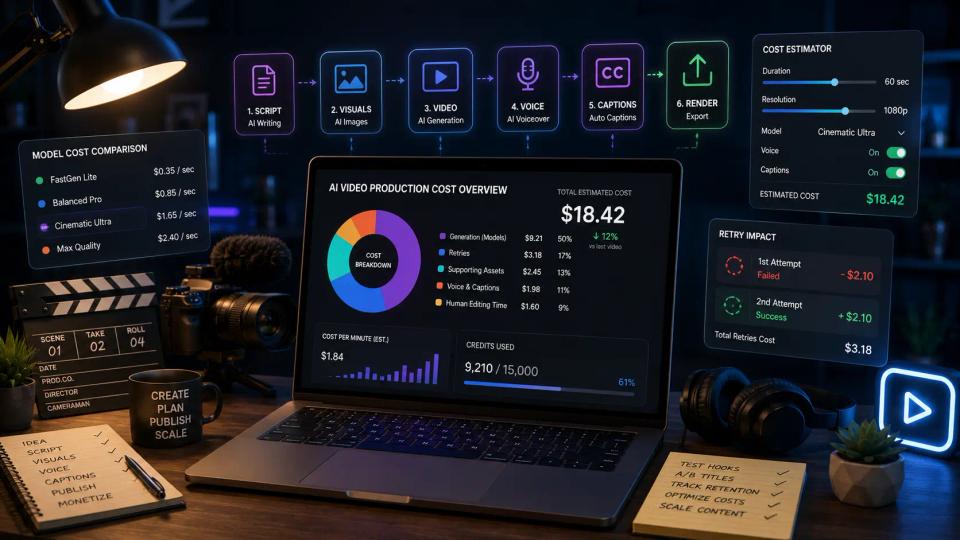
One of the biggest problems in AI video generation is unpredictable pricing. Creators need visibility into:
- generation costs
- render estimates
- credit consumption
- model pricing differences
- resolution impact
- workflow efficiency
Different videos require different models. A cinematic product ad may need one workflow.
A fast educational Short may need another. The best AI creator platforms in 2026 allow creators to switch models depending on quality, speed, or budget instead of locking production into a single pipeline.
Where Crealix AI fits
Crealix AI is designed around the idea that faceless content creation is an operational workflow, not a single generation step. Instead of positioning itself as a one-model demo tool, Crealix AI acts as the orchestration layer for AI creators. The platform combines:
- AI video generation
- AI image generation
- AI voice workflows
- captions
- rendering pipelines
- media organization
- multi-model workflows
- credit estimation
- creator-focused production systems
inside one creator workspace. For faceless YouTube creators, that means production becomes repeatable. A creator can standardize:
- scripting structure
- image style
- voice direction
- caption formatting
- render settings
- model selection
- publishing formats
without rebuilding the workflow for every upload. Instead of optimizing a single clip, the goal becomes optimizing the entire content pipeline. That difference matters at scale.
Multi-model workflows are replacing single-model platforms
The AI creator economy is moving away from single-tool workflows. Creators increasingly need:
- one model for cinematic shots
- another for speed
- another for image generation
- another for motion consistency
- another for voice
The future belongs to platforms that orchestrate these systems together. That is why workflow architecture matters more than individual model hype.
Recommendation for creators in 2026
If you only generate occasional cinematic experiments, a standalone model interface may be enough. But if you are building:
- a faceless YouTube channel
- a Shorts brand
- an AI storytelling account
- an educational media page
- a creator business with publishing schedules
then workflow efficiency becomes the real competitive advantage. The best AI video generator for faceless YouTube channels in 2026 is not simply the tool with the flashiest output. It is the platform that helps creators:
- test ideas faster
- estimate production costs
- maintain visual consistency
- reduce editing friction
- publish repeatedly
- scale content systems predictably
That is the difference between an impressive demo and a sustainable channel.